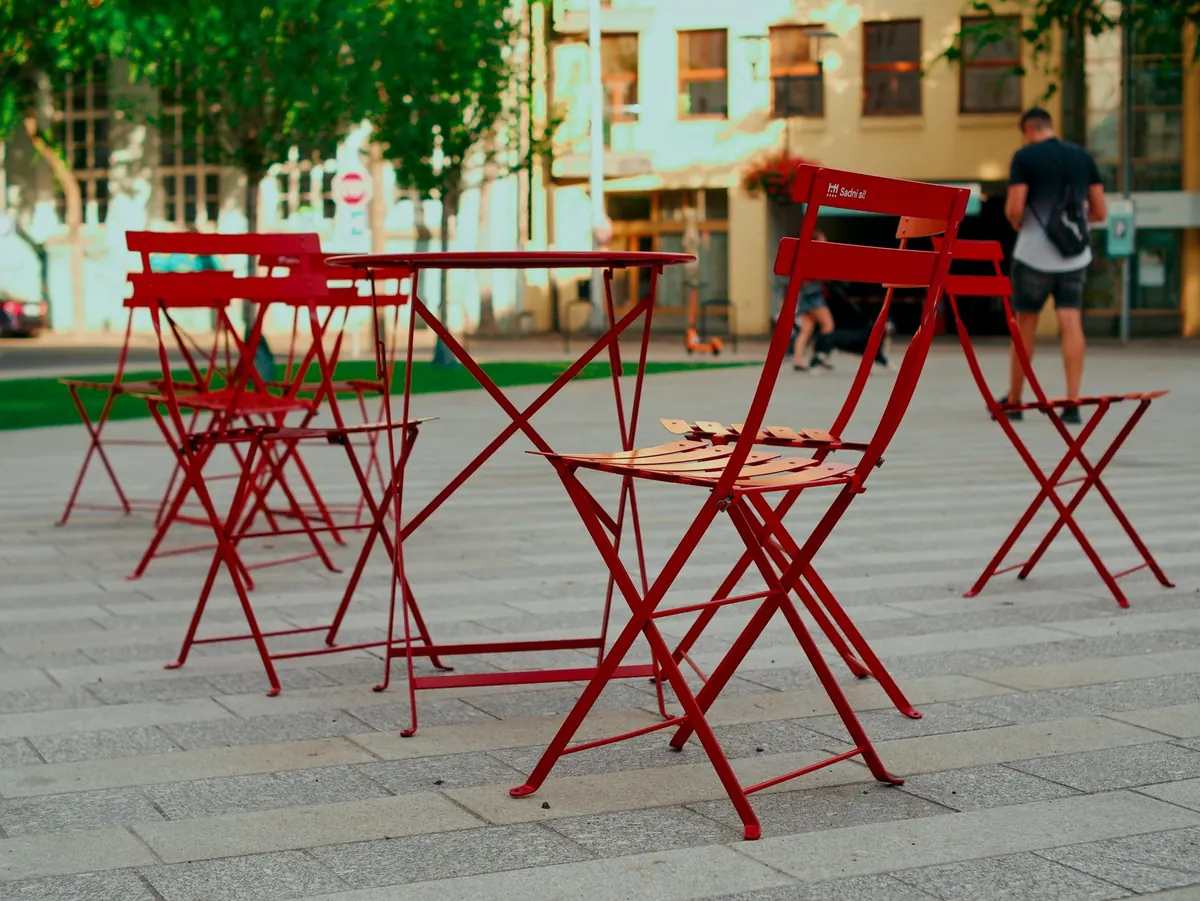
A cafe terrace has a hard life. Chairs are dragged across stone, stacked at midnight, wiped down between services and left out under whatever the sky decides to do. Furniture that looks handsome in a showroom can become a liability by the second summer: wobbly legs, rust blooms at the welds, cushions that hold water for three days. The good news is that durability is not luck. It is a set of decisions you can check, in person, before you place an order.
Start with the frame, not the finish
Most failures begin at a joint, a foot or an edge — the places photographs never show. Turn the chair upside down on the shop floor. Look at the welds: they should be smooth and continuous, not lumpy blobs with gaps. Run a thumb along the underside of the seat where the coating ends. If you can feel bare metal or a sharp edge, water will find it.
Powder coating is only as good as what sits beneath it. A properly pre-treated aluminium frame with a generous coating will shrug off rain for years; the same shape in steel with a thin coat will spot with rust the first time a chair is knocked against a table leg. On the coast, pay attention to the screws and rivets too. Stainless hardware is worth insisting on, and in salt-heavy air, a higher grade than the standard fitting is money well spent.
- Powder-coated aluminium: light, rust-free and the natural choice for stackable bistro chairs. Check that the coating covers the feet and the inside of the legs, not just the visible surfaces.
- Teak and dense hardwoods: warm and heavy. Excellent for tables, benches and planters; less practical for chairs that get stacked and shifted twenty times a day.
- Steel: sturdy and often affordable, but it demands a flawless finish. Any chip becomes a rust spot, so buy from suppliers who sell touch-up paint in the same colour.
- Compact laminate and ceramic tops: the sensible workhorses for tables. Water gets in at the edges, so inspect the sealing and avoid tops with exposed chipboard cores.
- Polypropylene and synthetic rattan: good value and easy to clean. The colour should run through the material rather than sit on the surface as a coating that will scuff white.
Stackability is a buying decision
If your terrace has to be cleared every night, stacking determines how quickly closing goes and how much storage you need. Ask to stack ten chairs yourself. A good stack goes up straight, stays stable and comes apart without a fight. Cheap chairs often nest badly from new, and after a season of grit between the frames they jam.
Look at what touches what. Frames that rest metal against metal will scrape the coating off each other within weeks; felt or plastic glides on the contact points prevent that. Also weigh the practical numbers: a stack of lightweight aluminium chairs can be moved by one person, while a stack of timber and cast iron cannot. Whoever closes the terrace at midnight will thank you for choosing the former.
Comfort that survives turnover
Guests forgive a lot, but they do not forgive a chair that is too low for the table or an armrest that traps them. Aim for seat heights around 44–46 cm with table tops at roughly 72–75 cm, and sit in the chair for a full ten minutes rather than a token thirty seconds. Armrests help older guests stand up and give people somewhere to put a handbag; they also make chairs harder to stack tightly, so decide which matters more to your service.
Cushions are where comfort and hygiene collide. Quick-dry foam with drainage channels, removable covers and mesh undersides dry far faster than a sealed block of upholstery. If you use loose seat pads, budget for more than you need and store them indoors overnight. Anyone who has watched a guest stand up in damp trousers will understand.
Furniture that cannot be repaired, re-covered or topped up with spare parts is not really an investment. It is a subscription.
Design the cleaning out of the product
Cleaning takes minutes per chair, several times a week, for years. Multiply that and the shape of a slat suddenly matters. Smooth surfaces beat decorative grooves; open frames beat hollow tubes with sealed ends that trap water; flat tabletops beat deep rims that collect ash and leaf litter. On a busy terrace, a simple wipe-down should be enough for daily service.
- Wipe frames and tops at close with a mild soap solution; avoid aggressive solvents that dull the coating.
- Clear crumbs and grit from stacking contact points weekly, or the chairs will grind their own coating away.
- Rinse the undersides and feet once a month, especially after pollen season or building work nearby.
- Retighten bolts at the start of each season, and touch up chips before damp weather arrives.
Buy things you can fix
Ask the supplier three questions before signing: can I buy single replacement chairs rather than full sets, which spare parts do you hold, and are the joints bolted or welded? Bolted joints can be tightened and replaced. Welded frames are stronger but need a welder you trust. Neither is wrong; knowing which you have is what counts.
Repairable furniture also ages better in appearance. A powder-coated frame can usually be recoated by a local workshop, teak can be sanded and oiled, and slings can be restrung. Build a small kit: spare glides, a box of the right bolts, touch-up paint and a note of the exact model name. In three years, that note will be worth more than the discount you were offered for ordering everything at once.
Wind, weight and the undersides nobody inspects
Exposed terraces need ballast. Umbrella bases should be heavier than the canopy suggests, and light stacking chairs should have somewhere sheltered to go when a storm is forecast. Glass tops are beautiful and perfectly safe when tempered and properly fixed, but on a windy corner they are simply more trouble than a solid laminate. Check that feet are adjustable — old pavers are never level, and a wobbling table sends guests hunting for a sugar sachet to wedge underneath.
The ten-minute test before you order
Before you commit to a hundred chairs, buy one of each shortlisted model and leave them outside for a week. Then do this: stack ten together, hose one down, sit in one for ten minutes, lift one above your head, and look underneath with a torch. Ask a member of staff to close the terrace with them once. Whatever irritates you in that single evening will irritate you every night for years.
And when you finally place the order, add two extra chairs and one extra table. Spares bought at the same time match exactly; replacements ordered later rarely do.